The post-workshop post-workshop process.
Most fires that "come back" never went out. They went underground. Workshops do the same thing. The room empties, people send "that was great" messages, and by Tuesday the embers are glowing under the floorboards. This is the process that runs the overhaul: five timed moves, two short, none requiring a meeting.
The Overhaul
The fire's out. The work isn't.
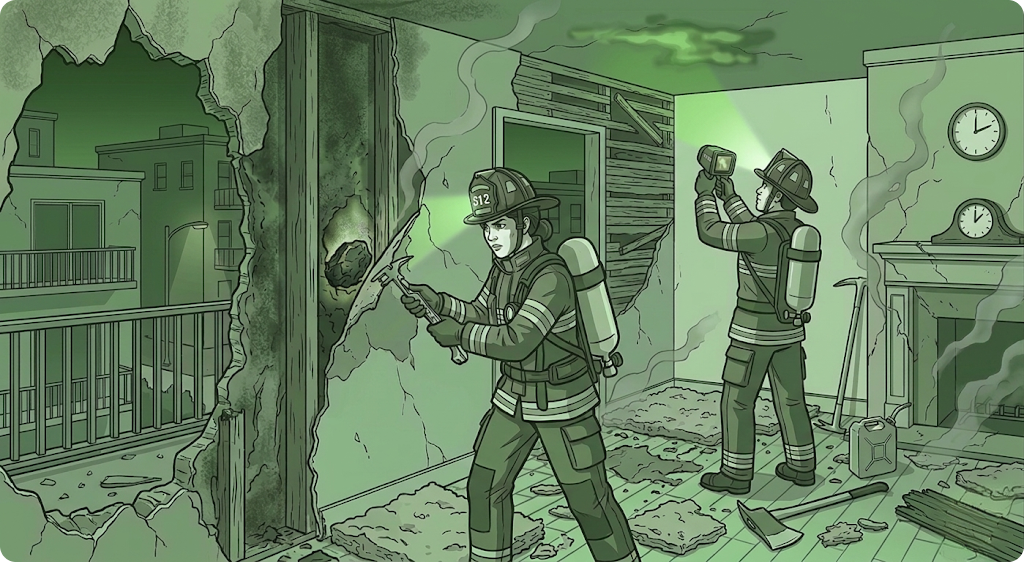
Firefighters have a phase nobody outside the job has heard of: the overhaul. The visible fire is out. The smoke has thinned. The crowd thinks the work is done. But the firefighters are still in there for hours — pulling apart walls, soaking smoldering insulation, finding the embers nobody can see. Most fires that come back never went out. They went underground.
Workshops do the same thing. The room empties. The whiteboards get photographed. People send Slack messages that say "that was great." Everybody leaves feeling like the work is done.
By Tuesday the embers are glowing under the floorboards. By Friday they reignite as confusion, drift, quiet resentment. By the next monthly review, you couldn't tell the offsite had ever happened.
Most workshops don't fail in the room. They fail in the overhaul nobody runs.
A Story
The strategy offsite that disappeared.
A few years ago I ran a two-day strategy offsite for a [TENTATIVE — fast-growing fintech]. Twelve people. Real money. The room worked. By day two, leadership was genuinely aligned on three priorities. The CEO finally made a clear ask he'd been holding for months. [TENTATIVE — One of the senior engineers teared up during the closing circle.] One of the best two days of running a session I'd done that year.
I sent the standard recap email Monday morning. Bullet list of decisions. Photos of the whiteboards. Three lines of next-step language. Nothing happened.
Three weeks later I checked in. The CEO kindly told me the offsite "had been valuable" but they "hadn't quite gotten to the action items yet." The three priorities had quietly become four, then six. The senior engineer was back to the work he'd been doing before the offsite. The genuine alignment we'd built had sublimated into the air over the following weeks. There was no specific moment when we lost it. It just dissolved.
I'd run a great workshop. I'd just never finished it.
Get the toolkit.
Free. Ready to paste, share, or print. You'll also be subscribed to the Workshopr newsletter: two articles a week and a Saturday weekly digest. Nothing else. Unsubscribe any time.
Download Post-Workshop ToolkitThe Process
Five timed moves. None require a meeting.
The process's timing is designed around how memory and motivation actually fade — same-day, next-morning, weekly, monthly, kill list. Each move is short. Each one sits exactly on a bump in the curve.
-
Same-Day Send — within 4 hours
Before they're back in their inboxes. While the emotional residue is still on them. One paragraph, two photos, the peak moment named, and one line of what happens by tomorrow morning. Not the recap — the recap is tomorrow. This locks the peak emotional moment into memory before normal life rewrites it.
-
24-Hour Recap — next morning, before 10am
Now you can be detailed. Three sections, no more: Decisions (in plain sentences — not "we had a productive discussion about X"; we decided X), Owners and Dates (every action item has a name and a date — if it doesn't, it's a wish), and The Unfinished List (what we explicitly didn't finish, and when we'll come back to it).
-
7-Day Pulse — one week later
Three lines. The thing we said we'd do by now (yes/no, not an essay). The thing that's quietly slipping (named, not implied). One question to keep us thinking forward. You're not chasing — you're keeping the work in their peripheral vision while intervention is still cheap.
-
30-Day Reignite — one month later
The hardest one. Most workshops are dead by day 30. Not a status update, not a check-in. A re-injection of the original energy in a smaller form: here's what we said we'd be feeling by now. Are we? One specific question that requires a real reply. The awkward replies are the actual product.
-
Dead Action Item Flag — whenever needed
Some items don't recover. The 7-day and 30-day moves tell you which ones. The process's last move is permission to kill them, in writing, with the team's blessing. Killed items are honest. Rotting ones are corrosive. Most workshops never include this step — it's the single most consequential piece in the process.
Get the toolkit.
Free. Ready to paste, share, or print. You'll also be subscribed to the Workshopr newsletter: two articles a week and a Saturday weekly digest. Nothing else. Unsubscribe any time.
Download Post-Workshop ToolkitWhy It Works
Three things are happening structurally.
Reason 1
The peak-end rule
People don't remember meetings as a continuous experience — they remember the peak emotional moment and the end. The Same-Day Send and the 24-Hour Recap are designed to anchor those two memories before normal life rewrites them. Without the anchors, the meeting becomes a vague, pleasant memory that fades into nothing.
Reason 2
The motivation curve
Energy from a workshop doesn't decay linearly. It drops fastest in the first 72 hours, levels out, and then drops again around day 30 when the original commitments meet the regular work. The process's timing — same day, 24 hours, 7 days, 30 days — sits exactly on the bumps in the curve. You're catching the moments where commitment is most likely to slip.
Reason 3
Social commitment
Naming what we said we'd do, with names attached, keeps the work in the social field rather than letting it retreat into private to-do lists. Private to-do lists are where workshops go to die. The process keeps them public for long enough to actually move.
A Note
On looking like you won't let go.
The first time you send a 30-day reignite, you'll worry you're being annoying. The CEO paid you. The work is done. Are you overstepping by pinging them a month later about an offsite that isn't even the current top priority?
Send it anyway. The reply usually comes back within an hour: "thank you for not letting this drop."
The fear of looking like you won't let go is mostly you projecting onto the team. They're worried about the same fade you are. They just don't have a structure for chasing it. When you send the reignite, you're doing the thing nobody else has the standing to do — and they're relieved.
The work the team needs you to do isn't the workshop. It's the overhaul.
The Bundle
Five files. Steal them.
Download the toolkit as a ZIP. Each move ships in two formats: paste-into-email plain text for fast use anywhere, and printable PDF in the Workshopr canvas style for handouts and offline reference.
Get the toolkit.
Free. Ready to paste, share, or print. You'll also be subscribed to the Workshopr newsletter: two articles a week and a Saturday weekly digest. Nothing else. Unsubscribe any time.
Download Post-Workshop Toolkit


 Pre-Session Briefing


 Analytics
 Full View


 Add unlimited notes to any activity
Comments & Discussion
Add a Comment
Recent Comments (3)
This workshop was incredibly effective for our remote team! We adapted it slightly for a virtual setting and it worked wonderfully. The key was breaking into smaller breakout rooms.
Great resource! One tip: prepare all materials the day before to avoid any last-minute rushes.
Used this for our quarterly planning session. The structured approach really helped us stay on track!