From sticky notes to
sharp decisions.
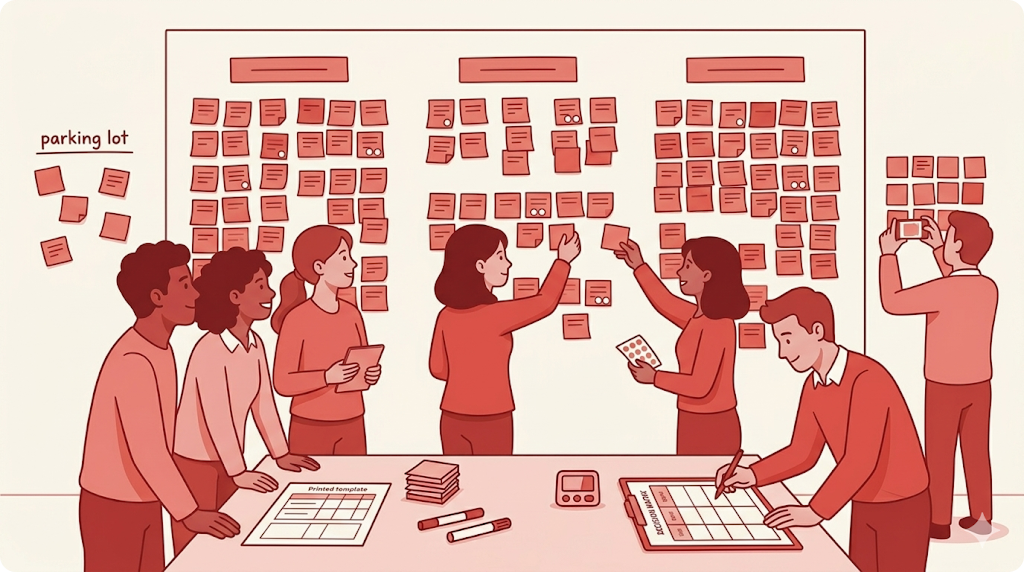
Exercises for ideation, research synthesis, prioritization, and convergence. Structured formats that help the quietest person in the room get heard.
Featured exercises for design teams
Activities that move groups from divergent thinking to aligned action — without the usual design-by-committee drift.
18F - Archetypes
Archetypes are user representations based on research. They synthesize qualitative data into actionable profiles. Unlike assumption-based personas, ar...
18F - Coding Qualitative Data
Coding qualitative data helps teams find patterns in research. This 90-minute exercise moves teams from raw data to structured insights. Participants ...
18F - Cognitive Walkthrough
Cognitive Walkthrough is a usability evaluation method. Evaluators step through tasks as a user would. It focuses on the actions users take to accompl...
"How Might We" Question Workshop
A ready-made workshop template from the Workshopr library. Load it into the Planner and adapt to your context.
Go deeper on design facilitation
Tools, tips, and frameworks for running better design workshops.
Running Design Sprints That Actually Ship
How to compress a week-long sprint into formats that work for real teams with real calendars. 36 pages of battle-tested patterns.
Download freeFacilitating Ideation Without Groupthink
Why "brainstorming" fails and what to do instead. Silent generation, structured sharing, and convergence techniques that work.
Read tipsThe Research-to-Action Gap
Your team did the research. Now what? How synthesis workshops bridge the gap between insight and implementation.
Listen nowPlan your next
design workshop
Open the Planner, drag in your exercises, and build an agenda that moves your team from research to action.


 Pre-Session Briefing


 Analytics
 Full View


 Add unlimited notes to any activity
Comments & Discussion
Add a Comment
Recent Comments (3)
This workshop was incredibly effective for our remote team! We adapted it slightly for a virtual setting and it worked wonderfully. The key was breaking into smaller breakout rooms.
Great resource! One tip: prepare all materials the day before to avoid any last-minute rushes.
Used this for our quarterly planning session. The structured approach really helped us stay on track!